Introduction
Decentralisation of the education sector has become the talk of the town as a response to the low-quality performance in education [1], [2], & [3]. These responses are based on Malaysia’s standing in PISA. This is similar to other countries that adopt the federal system [4]. But there is an aspect that we often overlook in the wider discourse of decentralisation in terms of providing student achievement which is basic infrastructure and physiological needs. This is nothing groundbreaking but the national discourse about decentralisation and improving academic achievement often overlooks this foundational aspect of how students can thrive academically and realise their full potential, particularly in the case of Sabah – the state that tends to rank the lowest in national assessment [5].
Students need to Maslow before they can Bloom
“Maslow before Bloom” refers to Benjamin Bloom’s educational learning objectives and Abraham Maslow’s hierarchy of needs. More specifically, the quote implies that before pursuing academic learning, people must meet their basic requirements. Bloom’s cognitive layers are subordinate to Maslow’s hierarchy. Maslow’s research, according to experts, has a direct impact on one’s capacity to learn, which is why human needs have traditionally taken precedence over academic goals [6].
Maslow’s hierarchy of needs is no stranger to educators everywhere. It is a theory of motivation, whereby a person’s conduct is determined by five categories of basic human needs. These needs include those for physiology, safety, love and belonging, esteem, and self-actualization. In terms of physiology, this refers to the most fundamental requirements for human survival such as food and water, enough sleep, clothing and shelter, general health, and reproduction. As for Bloom’s taxonomy, among its many other applications, it is a hierarchical classification of cognitive abilities that can support both teacher instruction and student learning [7].
At the micro-level, within the context of a school compound, some aspects mentioned in Maslow’s hierarchy of needs are generally provided by the school administration. However, at the macro-level, especially in the case of Sabah, from the figures shown below (extracted from the Department of Statistics Malaysia), in relation to other states in Malaysia, the incidence of poverty is the highest, and the state also has the most minimum access to electricity. On top of that, it has minimum access to piped water at home.

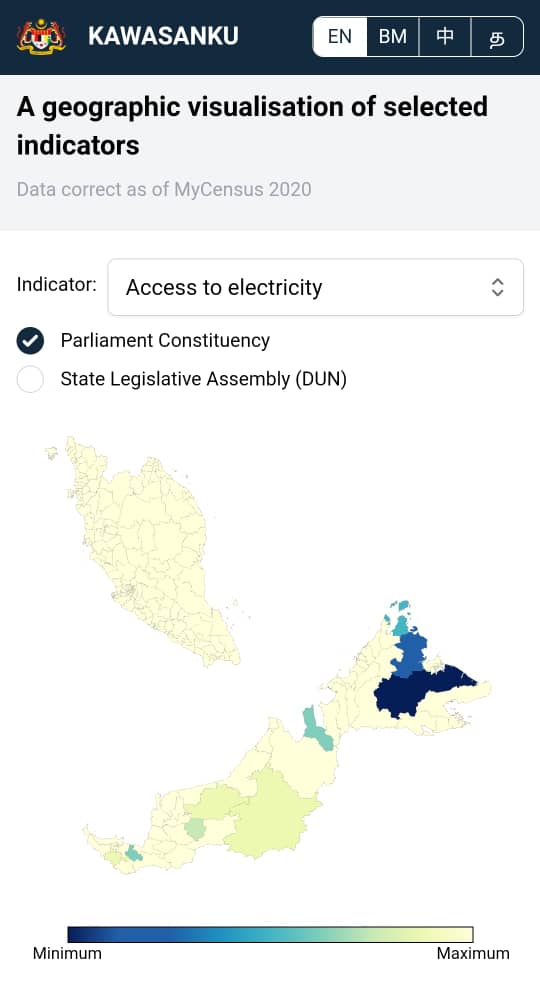

This shows that many of the basic needs according to Maslow’s hierarchy of needs are not met in certain constituencies in Sabah, such as water and electricity. Electricity is needed so that students can study even during the night. On top of that, socioeconomic status also influences educational attainment [8]. With the high rate of poverty, perhaps some students couldn’t often go to school or study because they need to help their parents to generate income for the family or parents could not afford to purchase educational resources for their children or invest in tuition, for example.
Therefore, how can the students in these constituencies in Sabah can ‘Bloom’ if their physiological needs are not met?
South Korea’s decentralisation of education and its unintended effects
Going back to the topic of decentralising education, South Korea is a prime example of the unintended consequences that happened after the educational reform [9]. Students who are academically failing and lack financial and cultural resources may find it difficult to navigate the complex educational system given the increased options and various curriculum. If decentralization of this kind would be implemented in Malaysia, imagine what could happen to Sabahan students in constituencies with high rates of poverty?
Conclusion
The ideas that have been put forth on decentralising education are profound and perhaps relevant, especially with the weaknesses that certain individuals have identified in a highly centralized education system. However, one should not forget that in Sabah, there are many basic infrastructures that have not been provided for the people in certain constituencies. Therefore, if we were to decentralize education, we need to also ensure that basic needs are met first because if not, decentralization will have its unintended effects, just like in the case of South Korea. Constituency representatives, please take heed of this.
Reference:
[2] https://www.eastasiaforum.org/2019/03/27/decentralising-malaysias-education-system/
[3] https://www.malaysiakini.com/letters/577610
[4] Wong, K. K., Knüpling Felix, Kölling Mario, & Chebenova, D. (2018). Federalism and education: Ongoing challenges and policy strategies in ten countries. Information Age Publishing, Inc.
[6] https://tophat.com/glossary/m/maslow-before-bloom/
[7] https://www.teachthought.com/learning/what-is-blooms-taxonomy/
[8] Thomson, S. (2018). Achievement at school and socioeconomic background—an educational perspective. Npj Science of Learning, 3(1). https://doi.org/10.1038/s41539-018-0022-0
[9] Lim, Y., & Park, H. (2022). Who have fallen behind? the educational reform toward differentiated learning opportunities and growing educational inequality in South Korea. International Journal of Educational Development, 92, 102599. https://doi.org/10.1016/j.ijedudev.2022.102599
Written by Auzellea Kristin Mozihim
Auzellea is an English language teacher based in Sabah, Malaysia. She was a Fulbright TEA (Teaching and Excellence Achievement) 2022 fellow to the United States. Her teaching interest is integrating ELT with citizenship education. As for her research interest, she is interested in exploring how public administration, public policy, and federalism influence the education sector, directly or indirectly. She is currently pursuing Masters in Administrative Science and Policy Studies.
 HIVE Educators | Cultivating teacher-scholars