
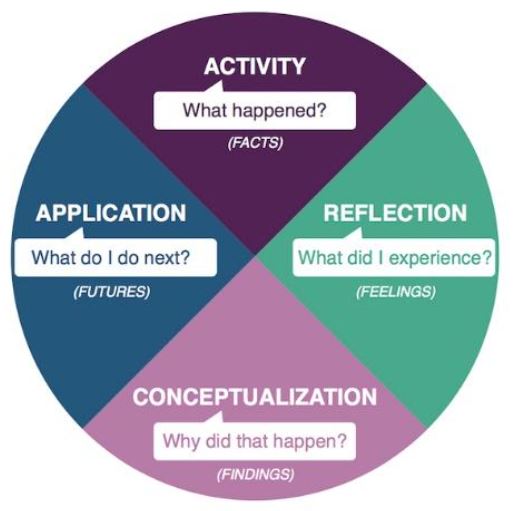
Recent trends in the educational setting have witnessed learning approaches that considers the experiences of learners in a more interactive manner as opposed to a more conventional one that is focused on the transmission of the knowledge. The advocates of this nature of learning based on the growing body of empirical research (Cleave-Hogg & Morgan, 2002; Dyer & Schumann, 1993) for the significant contribution of experiential learning in enhancing students’ metacognitive abilities, their capacity to apply newly acquired skills and knowledge to real-life situations, and the ability to become self-directed learners (Kolb & Kolb, 2006). As efforts to improve teacher education continue and evidence of experiential learning’s effectiveness increases so does the need for innovative ways to incorporate an experiential approach into teacher education courses. The experiential learning theory, rooted in the learning theory models of Lewin, Dewey, and Piaget (Kolb & Kolb, 2005; McCarthy, 2010), emphasizes the core importance of experience in learning, an addition to traditional theories focused on acquisition, manipulation, and recall (Kolb, 1984). Experiential learning is defined as follows: “a purposeful process of engaged, active learning in which the student constructs knowledge, skills, or values by means of direct experiences in authentic, “real world” contexts. It puts the learner in the centre of their learnings” (Australian Government 2014, p. 29).
In view of the positive outcomes of the experiential learning process, Kolb’s experiential learning framework was adopted in a drama course in a teacher education programme for the purpose of gaining insights into the nature of the learning that occurred. TSLB3233 Drama is a compulsory core course for pre-service ESL teachers in institutes of teacher education in Malaysia and the topics in the course cover a range of both theory and skills in drama and performance. The assessment for this course required a range of tasks that are significantly learner-oriented which included the selection of a play, the adaptation of the script and the final performance of the adapted play. By allowing the students to take charge of their own learning, this article explored the nature of their learning experiences and the insights gained throughout the entire process. Excerpts from interview sessions and their reflective journals are shared as evidence of their learning journey.
Learning Experiences – Importance of Team Work and Collaboration
“The most significant learning experience for me is that to be able to plan and organize a big scale play. This is because I never did a project this big. This project help to let me to be able to plan something new and discover a new side of me” (Cia, Interview)
“The most significant learning experience for me was how to work together as a team in all aspects of the production. From script writing, prop making, and the flow of the play itself-all of it required the collaboration of all members to make it a success” (Fi, Interview)
“For me, the most significant learning experience that I found valuable was carpentry and social relationship skill development. I am grateful to have been able to work on the prop-making and determine that I was able to make meaningful relationships with the juniors and gain respect from the TESL seniors” (GB, Interview)
“The most significant learning experience I have gained is on how to cooperate with classmates to perform the drama successfully because without the value teamwork, we would not be able to give opinions and communicate well with one another” (Holly, Reflective Journal)
“I have learnt is that we must have respect for our colleagues. A successful production in the drama requires contributions from everyone involved, therefore mutual respect is critical. Working on a production teaches us to respect and trust our colleagues’ abilities and talents” (Jay, Reflective Journal)
Learning Experiences – The Challenges
“The most challenging learning experience for me is time management as I must deal with assignments, making props, and dance practices along the preparation of the drama” (Elly, Interview)
“The most challenging learning experience for me is creativity. When creating the Aladdin storylines, I must make sure that it differs from the original while yet having the same characteristics as Aladdin and the ideas it wishes to convey. Writing compelling, flowing, natural dialogue is also challenging. Keeping the dialogue engaging for 20+ pages is not exactly effortless. And it is important to write a story that will hook you. Deciding on the ending was also a big dilemma for me. The ending matters. Big time. It might even matter more than it should. The perfect ending makes you happy that you spent time watching the film. It should not be too happy if a happy ending would betray the story. But make it too depressing, at the end of a depressing movie, you could question the writer’s motive. Then there is the matter of being obvious. Ideally you should not see it coming from scene one” (MaJ, Reflective Journal))
Insights – The Skills gained
“The most significant skill that I gained from the performance is time management. The practice sessions of the drama consume a lot of our time. At the same time, we also need to do our assignments and tutorials. Therefore, I can manage my time very well to ensure that everything can be done right on time” (Em, Interview)
“The most significant skill that I have gained from the drama is oral communication skill. Performing in front of an audience helps me develop the confidence needed to speak clearly, lucidly, and thoughtfully. Acting onstage helps me how to be comfortable speaking in front of large groups, and some of drama classes provide me with additional practise speaking in front of groups. Furthermore, my experience on friends has taught me that the best oral communications are clear, precise, and well-organized” (Hellie, Reflective Journal)
“The most significant skill I gained is teamwork and leadership. Practical drama is, in its very essence, a collaborative activity. Working with others can lead to greater tolerance, empathy, and inclusion. Students are more able to work independently where they can learn from and support each other while working towards a shared goal. Leadership skills can be developed as students take responsibility for different aspects of the shared work” (Fio, Reflective Journal)
“I gained how to become tolerant to others. As humans, it is normal to have different opinions and as the director, I must listen to different sides of people so that I can come up with a solution. Although it was a very tiring phase, I became more understanding towards my classmates because I knew everyone wanted the best” (Charl, Reflective Journal)
Insights – Drama Concepts
“The most useful element of drama was that I found useful was the creative usage of space and setting of atmospheres. This skill has helped me in cleaning my personal space in my house and gave me a deep-insights on life regarding how these elements of drama relate to the meaning of life, where how you space out yourself and set the atmosphere and environment is highly valuable for your self-happiness” (Fafa, Reflective Journal)
“The concepts of drama and performance that is useful is the audience, characters, and plot of the drama. The audience were so lively and supportive all the way until the end of the dramatization. In terms of characters, all characters did their role very well and manage to captivate the audience attention. The plot of the drama is also simple but engaging” (Siti, Interview)
“Some of the concepts of drama and performance that I found most useful is a dramatic metaphor. Metaphor in drama involves the second reference in order to enhance the meaning of the first. The use of metaphor in drama is a complex device used by playwrights to draw a comparison between two seemingly dissimilar things. For example, in the original drama, Aladdin told Jasmine that “You should see these places. I mean there is a whole world outside of books and maps” (Cornelius, Interview)
“For me, some of the concepts of drama and I performance that I found most useful were the characters and movements. Through the drama, I learned that in order to bring out the best out of the character, you have to learn the characterization or behaviour of the character and try to truly immerse yourself in that character. As for the movements, I learned that body movements are important because they act as a non-verbal communication. While communicating with the other characters, they also communicate with the audience. If they perform with their backs facing the audience, the audience cannot understand what they are trying to say. In real life, facing the person while communicating is important so that they know that the receiver knows that they are interacting with the speaker” (Jayne, Reflective Journal).
The elements entrenched within Kolb’s framework, gave the student-teachers the opportunity to gain concrete experience, active experimentation, and reflection throughout the entire learning experience. The present work captured these learning experiences which showed promise in the way of structuring performance-based courses such as drama within an experiential learning framework.
References
Cleave-Hogg, D., & Morgan, P.J (2002). Experiential learning in an anaesthesia simulation center: Analysis of students’ comments. Medical Teacher, 24(1), 23-26.
Dyer, B., & Schumann, D. W (1993). Partnering knowledge and experience: The business classroom as a laboratory. Marketing Education Review, 3, 32-39.
Kolb, A.Y., & Kolb, D. (2005). Learning styles and learning spaces: Enhancing experiential learning in higher education. Academy of Management Learning & Education, 4(2), 193-212.
McCarthy, M. (2010). Experiential learning: From theory to practice. Journal of Business and Economic Research,8(5), 131-139.
Written by Shubashini Suppiah

Shubashini Suppiah is a teacher educator at the Institute of Teacher Education Gaya Campus in Kota Kinabalu, Sabah Malaysia. Her areas of research interests are teacher education and teacher professional development, reflective practice approaches and digital literacy in the ESL classroom. Read her previous articles here and here.
 HIVE Educators | Cultivating teacher-scholars