
INTRODUCTION
This ongoing action research, conducted by the English Language Panel, is dedicated to improving students’ oral English communication skills, emphasizing correct pronunciation and grammar. A significant number of students at Sekolah Kebangsaan Unico Desa struggle with spoken English, with approximately 90% of students exhibiting weaknesses in this area. The chosen strategy involves engaging students in fun and simple projects to foster English communication in real-life situations. Their performances are recorded and posted on platforms like YouTube and TikTok.
The participants in this action research are Year 3 students, and the researcher is their subject teacher. This setup allows for continuous monitoring and implementation of the project without disrupting the students’ learning. Effective speaking skills, including pronunciation, word comprehension, and becoming better speakers, are the primary focus of this research. These skills are crucial for demonstrating English fluency. Past teaching experience revealed common issues among students, such as difficulty pronouncing words accurately, limited vocabulary, and challenges forming simple sentences, likely due to the lack of vocabulary and limited exposure to English in daily life.
OBJECTIVES
The objectives of this action research are as follows:
1.To provide opportunities and encourage pupils to use English language in and out of the classroom.
2.To improve pupils’ speaking skills with the correct pronunciation and intonation.
3.To help pupils gain more confidence in using English language confidently and independently.
4.To improve pupils’ learning performance to its highest level of PL6.
RESEARCH QUESTIONS
1.Can Fun and Simple but Interesting Projects (FSIP) help pupils improve their pronunciation and speaking ability?
2.Can FSIP assist pupils in making effective presentations?
3.Can FSIP help pupils build their confidence in using English?
PARTICIPANTS
This research involved 32 Year 3 students with mixed abilities. They resided in a village where Malay was the primary language of communication in their daily routines. Participants were selected based on pre-test results, which indicated the need to improve reading comprehension and correct sentence writing. Many of the participants came from backgrounds and environments where English usage was limited. This lack of exposure led to students lacking confidence in using English and feeling shy when attempting to speak it. Nevertheless, the participants demonstrated eagerness to learn English, suggesting that with motivation and support, they could eventually master the language.
IMPLEMENTATION OF ACTION
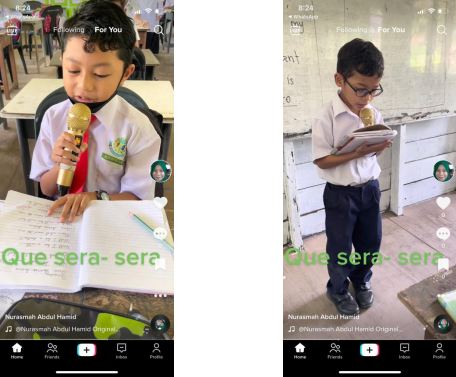
1.ACTIVITY ONE
Name of activity : Singing Que sera-sera
Skills: 5.3 Express an imaginative response to literary texts
5.1 Demonstrate appreciation through non-verbal responses
Tik tok link : https://vt.tiktok.com/ZSR13hna5/?k=1
Task description
-Pupils were given the script with few missing words.
-Pupils will listen to the song sang by their teacher
-Pupils then fill in the missing words based on what they heard.
-Later on, they will sing the song together.
-Then some pupils will come in front to sing the song.
2.ACTIVITY TWO
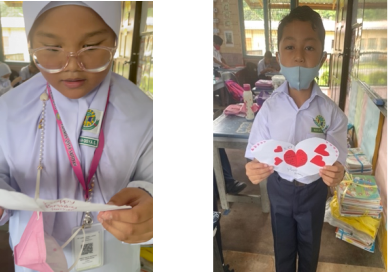
-Name of activity : Birthday wishes for their teacher
-Skills: 2.2 Use appropriate communication strategies
2.3 Communicate appropriately to a small or large group
Tik tok link : https://vt.tiktok.com/ZSR1n6VLe/?k=1
Task description
-Pupils were given a template of a writing a simple poem to their teacher and write it into a card form
-Pupils do the project individually at their own desk.
-Pupils then do the video presentation in front of their teacher.
3.ACTIVITY THREE
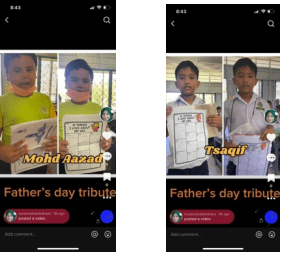
-Name of activity : Father’s Day tribute (English Day activity)
-Skills: 2.2 Use appropriate communication strategies
2.3 Communicate appropriately to a small or large group
Tik tok link : https://vt.tiktok.com/ZSR1toAPP/?k=1
Task description
-Pupils were given a worksheet of the 10 favourite characteristic of their beloved father
-Pupils do the project individually at their own desk.
-Pupils then do the video presentation in front of their teacher
4.ACTIVITY FOUR
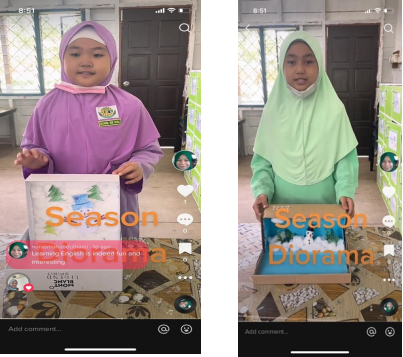
-Name of activity : Season diorama
-Skills: 4.2 Communicate basic information intelligibly for a range of purposes in print and digital media
2.1.5 Describe people and objects using suitable words and phrases
-Tik tok link : https://vt.tiktok.com/ZSR1t3sCj/?k=1
Task description
-Pupils were given a task to do a season diorama
-Pupils do the project individually at their own desk.
Pupils then do the video presentation in front of their teach
5.ACTIVITY FIVE
-FEEDBACK VIDEO
Tik Tok Link : https://vt.tiktok.com/ZSRJY1LgS/?k=1
Task description
-Pupils were given 2 task. One is written feedback and the other one is written feedback
-They did a great job and enjoy themselves while doing it!

Findings
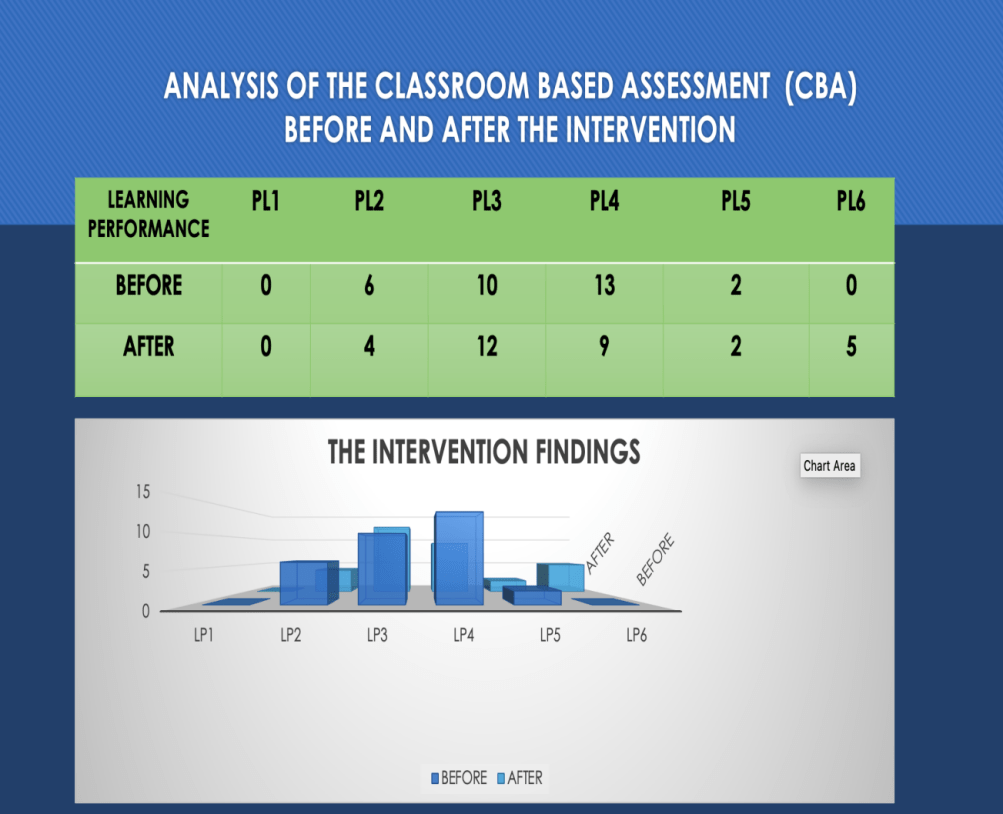
METHOD & DATA ANALYSIS
I used three methods which were interview, observation and document analysis. In addition, instrument used were interview form, pupils’ feedback and document worksheets to gather the data. The data gathered then were analysed and interpreted.
Observation
Document analysis
Most of the participants showed improvement through the activities given to them.
The researcher filled the checklist form for each session. In the beginning, the pupils showed confusion in doing the activities. They also showed low level of confidence, but their confidence level gradually increases throughout each session. Basically, all the participants gave positive behaviour in all the sessions.
Interview
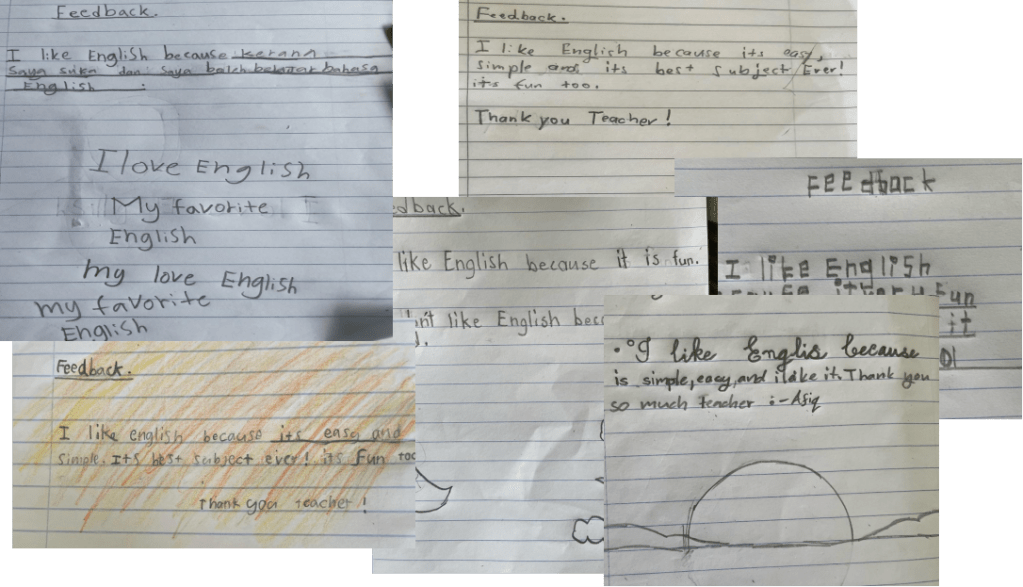
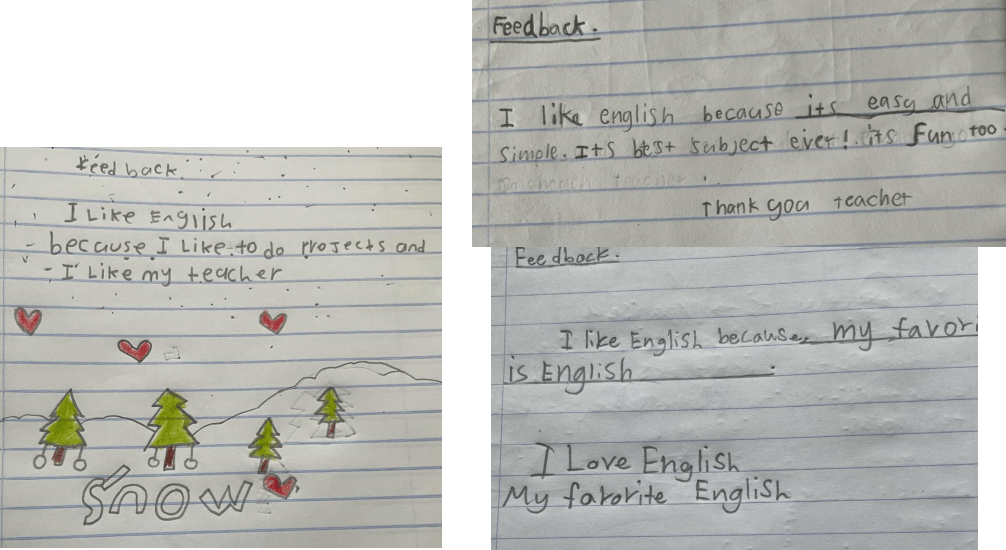
The interview sessions were conducted in each session. Basically, the participants could give suggestions and opinions regarding the intervention. All of them were giving positive feedback and happy doing the activities.
IMPACT OF STUDIES
The researcher studied on the effectiveness of the students presentation and project. As a result, it clearly showed that it was effective to help pupils improve their speaking and public speaking persona. The participants had shown positive results in pronunciation, reading comprehension and the speaking exercises
Firstly, the feeling of satisfaction of seeing their finished product. It gave them a new confidence and their eagerness to see their presentation on videos to be posted on the classroom WhatsApp group and eventually to YouTube.
Next, the researcher also found that project can provide fun learning environment to the pupils. The task can be challenging for them but offered the participants fun and interesting ways to create a finished product which later they can showcase to their friends.. They are free to create their own idea and they can make as many as their want. This builds their confidence in leadership . Thus, the anxiety in learning English had been reduced as projects can create positive environment that helps the pupils in achieving the learning objectives.
This study also finds that guided practice and scripts from the teacher gives feedback to the pupils. Guided practice also leads to active learning and improve the pupils’ pupils skill. The purpose of guided practice is to guide initial practice, correct mistakes, reteach (if necessary) and provide sufficient practice so that students can work independently. (Renard,2019).
Finally, cooperative learning helps pupils improve their pronunciation and intonation. When the pupils practice speaking, it actually build up their confidence lained to each other.
Overall, the findings of the research proved that this research successfully answered the research question. FSIP was truly effective to improve the pupils’ pronunciation and intonation and built up their confidence tremendously.
SUGGESTIONS FOR FURTHER IMPROVEMENT
First and foremost, this intervention can be improved by adding the number of students participation by doing it in a form of group work. The reasons for this suggestion are to involve more pupils .As this project was started during the tight Covid-19 implementation, most of the work were done individually.
It will be more fun and motivate the pupils to learn if they can communicate among themselves.. A study by Lopez (2017), found that ICT has positive impact on students’ performances in primary schools particularly in English language.
In conclusion, FSIP do indeed Improving Speaking Skills In English Language through FUN, SIMPLE, INTERESTING PROJECT
REFERENCES
Baker, J., & Westrup, H. (2003). Essential Speaking Skill. London: Continuum.
Don, Z. M., Abdullah, M. H., Abdullah, A. C., Lee, B. H., Kaur, K., Pillai, J., & Hooi, M. Y. (2015). English Language Education Reform in Malaysia: The Roadmap 2015-2025. Putrajaya: Ministry of Education Frantzen
Gill, R. S. (2013). Enhancing English Teacher Language Proficiency: The Malaysian Experience.
https://www.britishcouncil.or.th/sites/default/files/dr.ranjit.pdf
Nunan, D. (1989). Designing Tasks for the Communicative Classroom. Cambridge: Cambridge University Press
Nadesan, N. and Md. Shah, P. (2020) Non-Linguistic Challenges Faced by Malaysian Students in Enhancing Speaking Skills. Creative Education, 11, 1988-2001. doi: 10.4236/ce.2020.1110145.
Written by NURASMAH BINTI ABDUL HAMID

She is a teacher at SK UNICO DESA, LAHAD DATU, SABAH.
 HIVE Educators | Cultivating teacher-scholars