
The paradigm of creativity and innovation
In the context of the modern world, which is marked by rapid change, the development of innovative ways of thinking and creative problem-solving within educational settings has emerged as an undertaking that needs to be addressed. This must be done to provide students with the knowledge, abilities, and mentality they will need to properly pass through the approaching challenges and opportunities. The simple act of passing on one’s knowledge is just one part of the varied function that we play as educators. Our mission is to cultivate an environment that is stimulating and supportive, one that encourages the growth of students’ capacities for critical thinking, promotes an understanding of a wide range of perspectives and stimulates the students’ innate creative abilities. Considering the current state of circumstances, it is crucial to acknowledge the basic significance of fostering and supporting creative thinking and innovation within the framework of an educational setting.
The phenomenon of creative thinking goes well beyond the basic act of memorization since it stimulates and empowers students to go into uncharted area, challenge established beliefs, and generate really unique ideas. On the other side, innovation may be seen as the implementation of innovative ideas to facilitate transformative development. When these two forces come together, they spark the growth of an innovative and engaging learning community. Therefore, students are given the tools they need to succeed in a global economy that is always evolving and more competitive.
The current piece of writing is an investigation into an assessment of methods that have been determined to be beneficial in the classroom environment to support the development of creative thinking and innovation. Students are equipped with the instruments and resources required to nurture their talents as creative problem solvers as a result of the implementation of these tactics, which enables them to participate in a learning adventure that will continue throughout their whole lives.
The P.L.A.Y concept
As a teacher, I actively incorporate the application of this idea into my teaching environment. The person exhibits a steadfast belief in the values of humanism and emotional intelligence as crucial elements of their teaching methodology. The creation of a safe and supportive classroom atmosphere is a vital factor that teachers ought to emphasize before beginning lessons. This setting acts as an amplifier to encourage the natural flow of learning in students’ lives. A crucial educational strategy in the field of education is the acquisition of information and skills via personal experiences and the acceptance of mistakes. I’ve reached a point where I recognize the value of combining two different theoretical frameworks and using them in real-world situations based on a reflective analysis of my experiences, which involved a combination of keen observation, rigorous experimentation, and several continuous attempts. In my educational efforts, I have integrated a humanism and emotional intelligence framework, which has resulted in the creation of the P.L.A.Y idea.
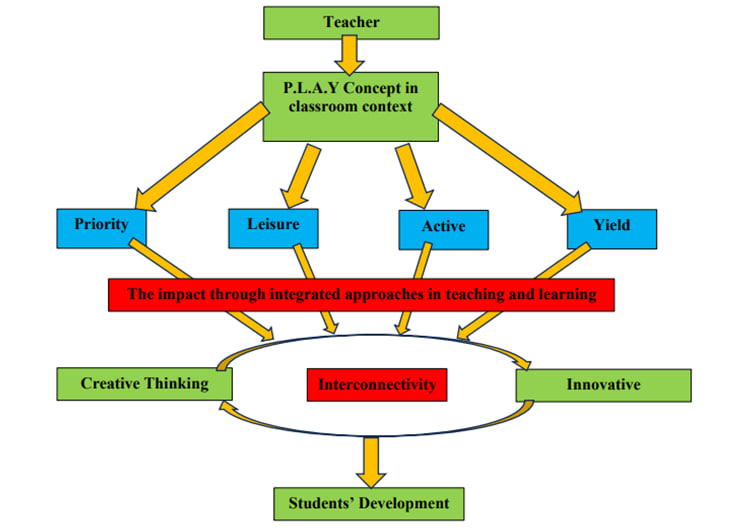
The core of P.L.A.Y is its focus on building a safe learning environment that promotes kids’ learning skills while making sure that the learning process is hidden from them. The goal is to clarify the fundamental properties of the enjoyable learning idea and any possible implications for educational practices. Priority, Leisure, Active, and Yield, or P.L.A.Y., is an abbreviation that stands for several key components that are crucial in the context being studied. When taken as a whole, these elements provide a thorough framework for comprehending and interpreting the topic at hand. By examining each P.L.A.Y. component, P.L.A.Y Concept in classroom context
Priority Leisure Active Yield Creative Thinking Innovative Students’ Development The impact through integrated approaches in teaching and learning Interconnectivity Teacher we may learn important things about the difference. The many acronyms used in the context under discussion each perform unique roles that are closely related to one another.
Establishing a clear grasp of the desired objective or purpose that we want our students to master before the teaching session starts is essential. In an educational setting, the act of lesson preparation and setting goals for our pupils is crucial. To properly personalize our teaching strategies, teachers must have a thorough awareness of the unique strengths and limitations of each of their pupils. In this setting, the word “PRIORITY” takes relevance. Understanding the relevance of priority is crucial to realizing how much attention should be paid to students’ requirements. After the teacher has set the objective, they must carry it out critically and innovatively, making sure that it properly satisfies the unique needs of the students.
The idea of creating a safe and secure atmosphere within the walls of the classroom keeps coming up. As a teacher, I personally avoid using strategies that are based on fear since they may prevent students from expressing their originality and ingenuity. People in this situation could feel inferior to others and have a predisposition to adhere to social standards, which inhibits their capacity for creative and independent thought. It is impossible to overstate the role that LEISURE plays in creating a safe learning environment in the classroom. In their contact with the students, the teacher takes a democratic stance, but they also uphold a certain set of rules that demand adherence. The teacher acknowledges and supports the custom of allowing students to eat within the boundaries of the classroom. A key element of my instructional strategy is the practice of asking students for feedback on my pedagogical practices. The teacher recognizes the significance of treating students as unique persons, appreciating their humanity, and fostering an atmosphere that is favorable to learning. The teacher highlights how important it is for students to feel at ease in the classroom so they may express their creativity and creative thinking. The teacher wants to promote a feeling of equality
and empowerment among students by refraining from being stern or intimidating.
It is crucial to include creative aspects into teaching techniques, carefully choose resources, and attentively plan classes to encourage student involvement and pleasure to create an atmosphere conducive to active learning. The suggested strategy aims to include many elements thought to be crucial for a successful learning experience. Higher-order thinking skills integration, mobility within the classroom setting, the use of gamification tactics throughout the learning process, and the promotion of hands-on activities are some of these components. The use of the chalk-and-talk technique should be treated cautiously since it has the potential to restrict creativity and prevent pupils from coming up with innovative concepts.
Students’ cognitive framework about during-class learning and attendance will change dramatically if they master the three P.L.A. components and overcome the challenge impeding their comprehension of learning. The last part of YIELD will definitely become apparent after students have encountered the many supporting factors that encourage a feeling of safety and appreciation. Students are likely to show a greater propensity to recognize and value our function as educators in their lives after interacting with the verbal discourse we supply. As a result, students will show a stronger dedication to following our instructions and working hard to achieve academic greatness.
In this writing, I will clarify how the P.L.A.Y idea is integrated by offering a comprehensive review of the many activities used over my extended teaching experience.
Language Arts as a medium
Students possess a wide variety of talents and capabilities that span several different fields. The incorporation of creative expression and language arts as essential components of the curriculum serves the twin objective of encouraging the growth and development of the students’ imaginative capacities. According to the results, the availability of a wide variety of artistic modalities, which may include but are not limited to painting, creative writing, music, and acting, may increase the likelihood that students will actively engage in a variety of different mental processes. The usage of these media enables students to more easily convey their ideas and feelings across a variety of communication channels, which is an extra learning benefit.
Project Based Learning (PBL)
Students have the chance to engage in meaningful, real-world difficulties when they participate in project-based learning, often known as PBL. PBL is a pedagogical technique. Students can develop their capacity for creative thinking and cultivate innovation when they are allowed to participate in real-world circumstances. It has been noticed that people develop a significant feeling of ownership and responsibility regarding their own learning endeavours as a result of the act of engaging in a variety of projects. This is especially the case when the projects include the individual’s own efforts.
Allow freedom and autonomy.
It would be wise that students be given some freedom to pick projects that are compatible with their particular interests to boost student engagement and motivation. This will allow students to more fully participate in class and be more motivated. This method makes it possible to create a more student-centered learning environment, one in which people are given the freedom to investigate issues that are relevant to their interests and spark their interest.
When teachers allow students to make their own decisions, they may instill in them a feeling of ownership and agency, which will eventually result in higher levels of passion, devotion, and overall academic success. Students are given the ability to take responsibility for their own ideas if when they are given autonomy within the context of the learning process. This helps to cultivate an environment that is amenable to students taking charge of their own education and learning in their own way.
Utilise technology as a resource.
The exploration of technology as an opportunity for fostering and enhancing creativity and innovation. The incorporation of digital platforms and software holds the promise of augmenting learning experiences, cultivating creative expression, and fostering collaborative endeavors, thereby expanding the possibilities for students’ innovative ideas. The acquisition of new knowledge is a source of enjoyment for students, particularly those situated within rural environments. In addition to the traditional chalk-and-talk approach, the integration of technology into the teaching process and providing students with exposure to it has the potential to ignite ideas and foster creativity in the learning experience.
Promote collaboration
Collaborative learning fosters an environment that facilitates the interchange of ideas, and diverse perspectives, and the cultivation of creative problem-solving skills. Group projects offer valuable opportunities for students to engage in collaborative learning experiences, fostering the acquisition of knowledge and skills through interactions with their peers. By working together, students can tap into the diverse perspectives and expertise of their group members, thereby enhancing their own understanding of the subject matter.
Additionally, group projects facilitate the development of essential teamwork skills, such as effective communication, coordination, and cooperation, which are highly sought after in today’s professional world. Moreover, the collective effort involved in group projects often leads to the generation of innovative solutions that may not have been possible through individual efforts alone. Overall, group projects serve as a platform for students to actively participate in the learning process, fostering a deeper understanding of the subject matter while simultaneously enhancing their collaborative and problem-solving abilities.
Establish a Secure and Conducive Environment
The establishment of a nurturing classroom environment is a critical factor in facilitating and nurturing the development of creativity. Establishing a conducive environment that cultivates a profound sense of safety and security is essential in facilitating an atmosphere where students feel empowered to openly express their thoughts and perspectives, free of constraints by any concerns of potential evaluation or criticism. Facilitate the promotion of peer support and the establishment of an inclusive environment that appreciates and embraces a wide range of perspectives, thereby nurturing a culture distinguished by collaborative efforts and transparent communication.
Conclusion
Rather than being the result of a single, isolated effort, the development of creative thinking and innovative practices in the context of the classroom environment is a dynamic and continuing process. The essential framework for promoting the development of innovative cognitive abilities by making a conscious effort to create an environment that encourages growth and incorporates educational techniques that emphasize the arts and project-based work.
Students are allowed to fully explore their intrinsic creative potential within an atmosphere that encourages the fostering of cooperation, autonomy, and resiliency within the educational framework. The commitment of the teachers to the development of students’ creative thinking has the potential to provide students with greater autonomy and the ability to develop into persons who are imaginative and flexible. In turn, this will enable them to make a meaningful and constructive contribution within a world that is always developing, which in turn will equip them to make a meaningful and constructive contribution inside the globe.
Together, we can build a group of people who are capable of recognizing and resolving difficult problems, engaging in analytical thinking, and continually pursuing the acquisition of new information. This collaborative strive will serve as a stimulant for development and serve as a source of motivation for transformational activities, as indicated by their inventive pursuits. This will be accomplished through serving as a source of inspiration.
The development of creative thinking and innovative practices within the classroom environment is not singular, isolated event, but rather an ongoing and dynamic process. The foundational structure for fostering the advancement of inventive cognitive capacities involves purposefully cultivating an atmosphere that nurtures growth and integrating educational methodologies that prioritize the arts and project-based learning. Throughout the educational journey, the utilization of the P.L.A.Y concept has the potential to greatly enhance teaching and learning experiences.
By effectively harnessing its advantages, teachers can effectively stimulate creative thinking and foster the development of students’ innovative capabilities both within and beyond the confines of the classroom. The elements within the P.L.A.Y framework demonstrate a high degree of adaptability and integration with various approaches and theories. This adaptability serves to enhance the overall process and input, which in turn has a significant impact on the output of the lesson. By incorporating these elements, such as the development of creative thinking and fostering students’ innovative problem-solving abilities, both within the classroom and in real-world scenario, the P.L.A.Y framework effectively supports student learning and growth.
Written by Desmond Sandum

Desmond Sandum has been a high school teacher for 13 years. Afterwards, advancing into management and administration at the Sabah State of Education under the sector of Educational Resource & Technology as the head leader for innovation and action research technology. He is devoted to action research, innovation, and pedagogies for teaching the English language. A fervent advocate of the P.L.A.Y. method of humanism-based teaching and learning. His fields of interest are Emotional Quotient (E.Q) in teaching and learning, ESL intervention (writing and speaking techniques) and Mentoring and Coaching.
 HIVE Educators | Cultivating teacher-scholars