
As an English language teacher, I always try to find innovative ways to synchronise my teaching and learning materials, assessments, additional references, and many other things to support students’ learning. In a technologically inclined climate of teaching practices that many learning institutions adopt nowadays, I find myself constantly trying to find a suitable platform to run my classes and staying sane to keep abreast with the fast-paced changes. Not to mention, I was really hesitant to change my ways – the chalk-and-talk approach works really well that I did not find reasons to change my techniques. And then I came across…..Padlet.
When I first started using Padlet, it was easy to navigate. I started with making simple activities like asking students to introduce themselves in ice-breaking sessions. What I discovered through using Padlet, students are more receptive to the idea, and they seem to respond well to technology use in classrooms.
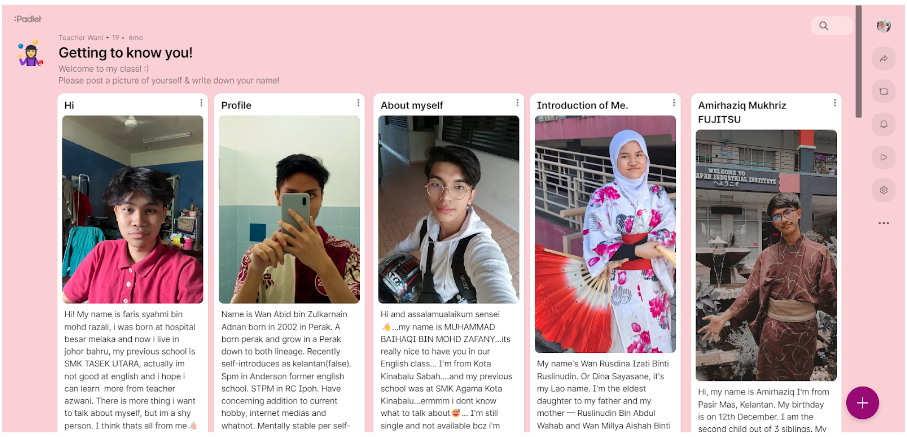
In relation to English language teaching and learning, it can be observed that my students put the effort to convey more information using the target language. However, other activities need to be supplemented to encourage them to present ideas verbally and allow students to interact by asking further and responding to questions.
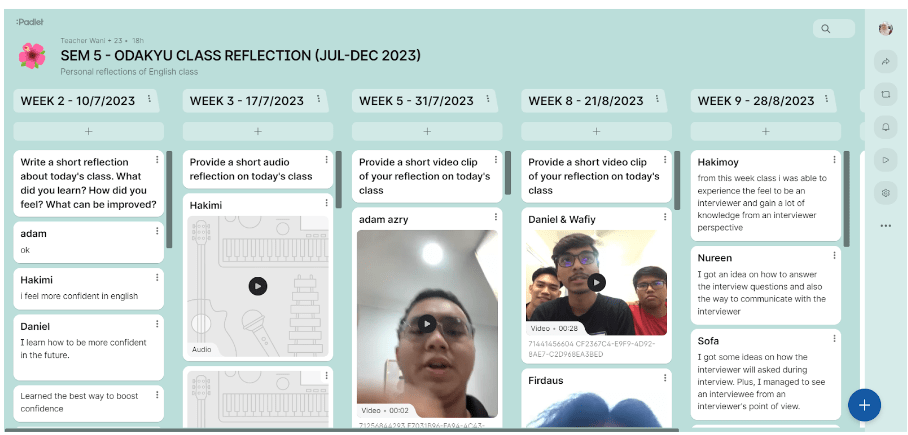
I further explored the use of Padlet to elicit more specific information like understanding students’ views and thoughts on certain topics and asking them to reflect on their learning. I was pleasantly surprised to see the positive responses by using Padlet. When asked, my students told me that they feel at ease in responding to class tasks at their own pace and to work together with their peers to produce answers. Furthermore, having time and privacy to personally learn provided a ‘safe’ space for them to learn the language and provide answers in their own ways.
Having positive streaks of luck with Padlet, I feel more confident to integrate the use of technology and I began to explore further ways to optimize the platform for my class management. The main idea is for me to put all class materials where they can be available for my students 24/7. I believe this will help students to navigate the platform and further motivate them to utilise the information to drive their learning. After all, this is what PAK-21 is all about, right?
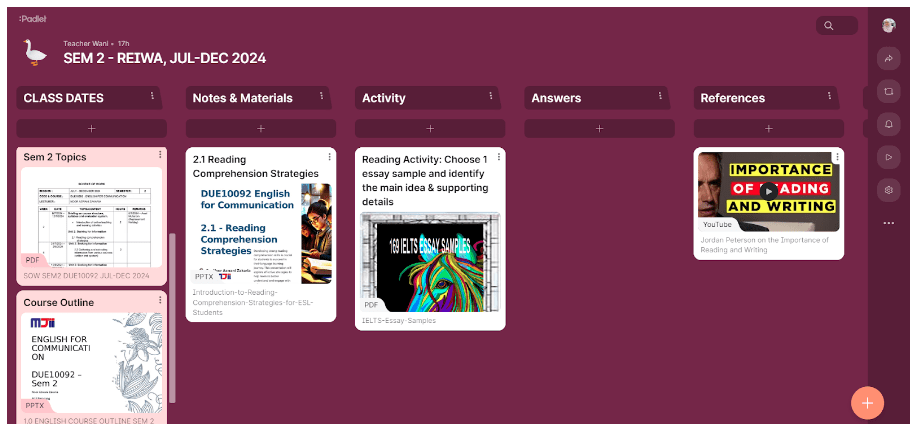
As an avid user of Padlet now, I strongly believe in its great potential to support teachers, as well as students to drive English learning among Malaysian students to greater heights. It is now the time to employ technology to encourage students to have better opportunities to engage in effective language learning platforms. To conclude, I believe Padlet is one of the powerful platforms that can be utilized by English language teachers to conduct PAK-21 classes. The ease of use and variety of activities that can be incorporated into the platform will surely make a lasting impact on students’ language performance.
Written by Noor Azwani Zakaria

Noor Azwani Zakaria is an English language teacher who is currently working in a local TVET institution. Her passion lies in empowering Malaysian engineering students’ English language learning by designing effective teaching and learning materials. Her latest endeavours is learning and adopting innovative language T & L techniques that could benefit her students and to improve her teaching practices.
 HIVE Educators | Cultivating teacher-scholars