
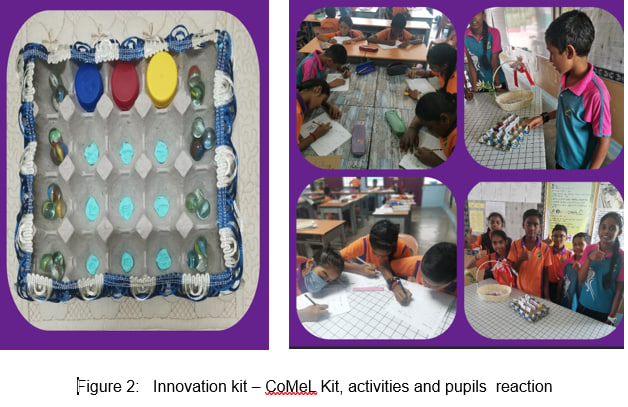
CoMeL Kit stands for Colour Memory Learning Kit. It’s a simple and attractive innovation kit to help pupils to write simple present tense sentences. This innovation kit helps pupils to enhance and learn through this kit. It is an effective and attractive learning tool that enable pupils to write simple sentences to grab the ability in writing and to create mood in pupils to learn in make writing lesson is fun to learn.
I choose primary colours such as blue, red and yellow. These colours attract pupils and have meaning to relate words in making simple present tense sentence that represent subject, verb and object. Subject, verb and object are the basic structure in making simple sentences. Pupils loves colours and these three basic colours are really play main roles when it comes to memory.
Why colours? Blue, red and yellow. Blue is stability and intelligent so used for subject. Red is energy and power shows the action represent verb and yellow means happy and cheerful as used for thing or gift. Colours really help pupils to understand and learn basic sentence pattern. It helps pupils to remember and write sentences independently. So the colours arranged in alphabetical order; Blue – Red – Yellow so that it will be easy to recognise the colours order and relate with subject, verb and object in simple present tense sentence.
Why need a kit ? After few lessons of writing, I analized the problems and the relationship of the problem found in a group of pupils that unable to use subject, verb and object words in correct order of sentence structure. These weak pupils jumbled up or mixed up the words – subject, verb and object that should be in order for a meaningful sentence. They wrote meaningless sentences. Some of the pupils not interested when it comes to writing lesson because they feel that writing is a boring lesson. To make them interested and engaged in writing this innovation kit helps pupils to understand and remember the colours and relate with the basic sentence structure.
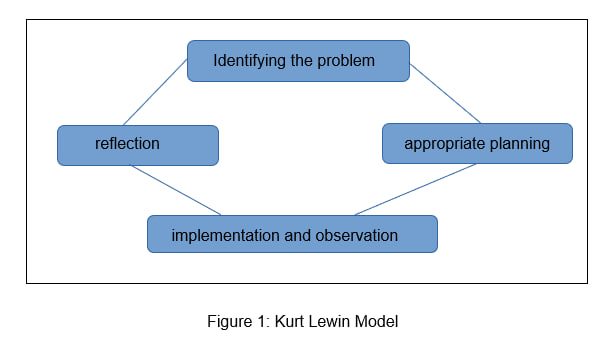
May be we will think that memorizing colours will make them unable to understand the sentence structure and just arrange according to the colours. Actually no. They were given explanation and simple identifying drilling activities on words list so they really understand subject, verb and object words in a simple sentence before they use kit to make simple sentences. I choose Model Kurt Lewin (Bartunek, et al. 2015). I use this method that has 4 steps – identifying the main problem – appropriate planning – implementation and observation – reflection. This model is easy and helpful in carry out the activity to help pupils to understand the basic skills using this colour memory learning kit.
How it works? This innovation kit is made from unwanted or waste egg-tray, ice-cream sticks and colour papers. It is a very low cost kit. After drilling activity on identifying the subject, verb and object words list, pupils use the CoMeL kit to arrange the words correctly in the slots based on pictures and guide words. Pupils actively took part and enjoyed the activity because they wanted to try hands-on activity for themselves because most of the writing lessons are very plain and using mind-map process in writing the sentences or writing essay. It is used as an extra teaching and learning kit to enrich and sustain the interest in writing. It is also a helpful innovation kit to apply to the weak and slow learners as a remedial activity. Through this kit pupils able to attain knowledge and improve writing level independently.
This kit used and implemented in English lessons and suggested to apply to weak pupils in Bahasa Melayu and Tamil language subjects too. Both panel heads very impressed and tried and used in Bahasa Melayu lesson and Tamil language lesson especially in writing skill.
REFERENCES / RUJUKAN
Bahagian Pendidikan Guru. (2001). Garis Panduan Pelaksanaan Kursus Penyelidikan
Tindakan Maktab Perguruan. Kuala Lumpur: Kementerian Pendidikan Malaysia.
Mohd. Majid Konting. (1990). Kaedah Penyelidikan Pendidikan. Kuala Lumpur: Dewan
Bahasa dan Pustaka.
Lai Kim Leong. (2007). Penyelesaian masalah Matematik sekolah rendah dengan menggunakan strategi melukis gambar. Koleksi Bahan Bengkel Inovasi Pedagogi Seminar Penyelidikan Pendidikan Institut Perguruan Batu Lintang Tahun 2007, 23-33.
Lee, K. C., Zakri Abdullah, & Chua, L. N. (2018). Penyelidikan dalam pendidikan. Shah Alam: Oxford Fajar Sdn. Bhd.
Mariam Adawiah Dzulkifli, & Muhammad Faiz Mustafar. (2013). The influence of colour on memory performance: A review. The Malaysian Journal of Medical Sciences, 3-9.
Abdul Said Ambotang & Shanti Gobalakrishnan. (2017). Tahap Integriti dan Kesediaan Guru dengan Pelaksanaan Pentaksiran Berasaskan Sekolah. International Journal of Education, Psychology Counseling, 2 (4), 1-22.
Adi Badiozaman Tuah (2007). National Education Assessment System: A proposal towards a more holistic education assessment system in Malaysia. Proceedings of International Forum On Educational Assessment System: Looking Ahead, 20-23 April 2007, Petaling Jaya
Ahmad, A. & Mahamod, Z. (2016). Tahap Kemahiran Guru Bahasa Melayu Sekolah Menengah dalam Melaksanakan Pentaksiran Berasaskan Sekolah Berdasarkan Jantina, Opsyen dan Tempat Mengajar. Jurnal Pendidikan Bahasa Melayu, 5 (1), 18-29.
Fraenkel, Jack R.& Wallen, Norman E (1993). How to design and Evaluate Research in Education. New York: McGraw-Hill.
Kamarudin Husin & Siti Hajar Abdul Aziz. (1997). Siri Pendidikan perguruan: Penguasaan kemahiran menulis. Selangor: Kumpulan Budiman Sdn. Bhd.
Lee, K. C., Zakri Abdullah, & Chua, L. N. (2018). Penyelidikan dalam pendidikan. Shah Alam: Oxford Fajar Sdn. Bhd.
Ambotang, A. S. (2013). Cabaran Transformasi Agenda Pendidikan Negara. Berita Harian. Minda Pendidik.
Written by: Teacher Yesumarial A/P Joseph from SJKT Ladang Chemor , Perak.
| Yesumarial a/P Joseph, guru Bahasa Inggeris yang berasal dari negeri Perak. Telah mendapat Sijil Asas Perguruan dari Maktab Perguruan Sultan Abdul Halim Sungai Petani, mendapat pendidikan Ijazah Sarjana Muda dalam TESL di OPEN Universiti, Perak. Beliau juga pernah mengambil bahagian dan mendapat rank ke 5 yang teratas serta ‘Special Award’ dalam pertandingan E-THICS peringkat kebangsaan & Asia Pacific pada tahun 2020. Beliau juga menyertai pertandingan inovasi kumpulan bersama rakan sekolah peringkat negeri Perak dan memproleh pingat Perak. Beliau juga merupakan seorang pegawai sukan Kesatuan Olahraga Amatur. Kini, bergiat dengan NGO- Special Olympics Perak, membantu dan melatih murid kurang upaya intelek (ID) dalam sukan serta bantu pertubuhan mengadakan program yang bermanfaat bagi mereka. |
 HIVE Educators | Cultivating teacher-scholars