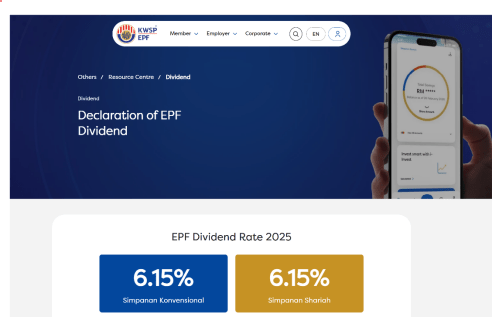
On 28 February 2026, the Employees Provident Fund (EPF/KWSP) announced a dividend of 6.15% for 2025, applicable to both Conventional and Shariah savings accounts. Although slightly lower than the previous year’s 6.30%, this announcement presents a unique opportunity for teachers to transform a real-world financial event into an engaging learning experience for students and young adults. By integrating this announcement into classroom discussions, educators can teach practical financial literacy, long-term planning, and entrepreneurial thinking.
Understanding EPF Dividends
The EPF is Malaysia’s largest long-term savings platform, designed to secure employees’ financial well-being for retirement. Monthly contributions from both employers and employees are invested across diverse portfolios, and dividends are distributed annually based on investment performance.
- Conventional savings provide a minimum guaranteed return of 2.5%, but actual dividends depend on how well the EPF’s investments perform.
- Shariah savings follow Shariah-compliant investment principles, with returns reflecting actual performance.
For students and young adults, understanding these dividends is not only about numbers but also about learning how money can grow over time. This knowledge helps cultivate financial discipline and planning skills, essential life lessons that go beyond textbooks.
Why Students and Young Professionals Should Care
Early exposure to financial concepts has a lasting impact. Students and young professionals who begin saving early can harness the power of compound interest, where both contributions and earnings generate further growth.
For instance:
- A student contributing RM100 per month starting at age 20 could accumulate more than RM15,000 over 10 years, assuming a 6% annual dividend.
- By age 30, with consistent saving, the amount could surpass RM70,000, demonstrating the exponential effect of disciplined contributions over time.
In Sabah, where opportunities for financial literacy programs are still growing, using the EPF dividend as a teaching tool helps students connect abstract numbers with real-life financial outcomes. Teachers can integrate classroom exercises where students calculate projected growth, set savings goals, and even plan hypothetical investments.
Connecting Financial Literacy to Entrepreneurship
Savings and dividends are not just about personal security, but they are essential for entrepreneurial planning. Many young people in Sabah are starting small businesses, such as selling handicrafts online, providing tuition services, or running food ventures. Understanding how EPF dividends work helps students grasp important concepts:
- Capital Planning: Savings can serve as seed funding for business ventures, reducing reliance on loans or external investors.
- Risk Management: Learning the difference between secure savings (like EPF) and higher-risk investments prepares students to make informed financial decisions.
- Financial Discipline: Understanding compounding and goal setting cultivates habits essential for running a successful business.
For example, a student in Kota Kinabalu saving part of their allowance or EPF contributions can accumulate enough to launch an online craft business or invest in marketing for their venture. By observing annual dividends, they also learn about investment performance and the importance of long-term planning.
Practical Classroom Strategies for Lecturers/ Teachers
Teachers can use the EPF dividend announcement to create meaningful learning experiences. Some practical strategies include:
- Track and Discuss Savings
- Encourage students to monitor their EPF or personal savings using the i-Akaun portal or mobile apps.
- Compare projected growth versus actual dividends to understand performance differences.
- Interactive Exercises
- Have students calculate how small monthly contributions grow over 5, 10, or 20 years.
- Include scenarios for both Conventional and Shariah savings to teach comparison and informed decision-making.
- Goal-Oriented Learning
- Ask students to link savings to personal or entrepreneurial goals, such as funding a small business, buying a laptop, or supporting further education.
- Discuss how dividends and compounding can accelerate goal achievement.
- Introduce Diversification
- Teach students about safe alternatives like Shariah-compliant fixed deposits or unit trusts.
- Encourage critical thinking by comparing different returns and risk levels.
- Link to Real-World Context
- Bring in examples from Sabah: local entrepreneurs, startups, or family businesses funded through personal savings.
- Discuss how financial planning influenced the success or challenges of these ventures.
By applying these strategies, teachers turn abstract financial data into tangible learning outcomes, fostering both financial literacy and entrepreneurial thinking.
Financial Literacy as Life Skills
Financial literacy is a critical skill, comparable to learning a language, understanding scientific principles, or mastering business concepts. Using EPF dividend announcements as teaching moments demonstrates practical, actionable knowledge that students can apply immediately.
In addition to savings, students can explore how dividends relate to broader economic principles, such as interest rates, inflation, and investment risk. These discussions help build analytical and decision-making skills, empowering students to take control of their financial futures.
Conclusion
The EPF 2025 dividend announcement of 6.15% is more than just a number; it is a teaching tool for pedagogy, financial literacy, and entrepreneurship. Teachers can use this real-world example to demonstrate the value of consistent saving, disciplined planning, and strategic decision-making. By linking dividends to student goals and potential business ventures, educators prepare students not only to manage money responsibly but also to think entrepreneurially and practically about the future.
In Sabah and across Malaysia, leveraging events like EPF announcements helps create classrooms where students actively apply knowledge, explore opportunities, and develop skills that extend far beyond textbooks. This is the essence of empowering students through pedagogy: turning abstract data into meaningful, life-changing lessons.
Written By Mary Grace K. Orow

Mary Grace K. Orow is a Business Studies lecturer at Cyberjaya College Kota Kinabalu, with over 11 years of experience in the retail banking sector. Her professional expertise spans customer relationship management, financial advisory, and digital banking operations, which she integrates into her teaching to bring real-world business insights into the classroom. Mary Grace focuses on digital transformation, financial literacy, and preparing students for the evolving demands of the business world. She is currently pursuing a PhD in Business Management at Universiti Malaysia Sabah (UMS).
 HIVE Educators | Cultivating teacher-scholars