
INTRODUCTION
Professional development in the contemporary educational landscape requires a continuous willingness to engage with evolving methodologies, global perspectives, and rigorous pedagogical frameworks. To hone my practice as a teacher educator, I recently completed a 64-hour professional development course delivered by Arizona State University (sponsored by the U.S. Department of State’s OPEN program). This intensive training has been a powerful catalyst, driving both my professional advancement and personal growth. Over the course of the program, I was challenged to transition from a practitioner-oriented mindset to a deeply analytical, meta-cognitive perspective on how teacher educators shape the next generation of educators. My reflection notes will critically examine my experience through three key insights which include the cognitive challenges of completing the online classes and assignments, discipline and time management, and the transformative power of validation within a community of practice.
ELEVATING THE TRAINER MINDSET
The primary value of the ASU-delivered curriculum is the high level of critical engagement and theoretical application that is demanded in all the class discussions and tasks as well as the assignments. The 64-hour online course comprised eight comprehensive modules designed for teacher trainers. Each module was strategically structured to guide participants in designing their own context-specific training plan. This directly supported the program’s primary goal which is creating a framework for cascading knowledge to other teacher educators. Personally, for me, I found Module 3 (Designing a Training Course Outline), to be the most challenging and also the one that was most valuable in providing the main framework for my training plan. In Module 3 we learnt about designing the course outline with its overall and specific goals and objectives as well as the assessment for our training plan. The input as well as the tasks in this Module really helped me to think about what I wanted to do, to achieve and to assess within a working framework. My training plan was built around the teaching practicum specifically on giving constructive and supportive feedback to teacher trainees during teaching practice and mentoring sessions for both novice and experienced teacher educators. The end-goal of my training plan was to have all my course participants to develop the skills to deliver high-quality, constructive and supportive feedback and build a personalized toolkit of feedback strategies to improve their effectiveness during teaching practicum supervision and mentoring.This was also the most time-consuming task as I was starting from scratch and slowly building up the training plan, carefully taking into consideration all the overall and specific goals and objectives, the types of interactive activities to keep my participants engaged and aligning the assessment to the overall goals. It took up a lot of time and effort on my part but seeing it at the end was really worth all of it more so with the very positive feedback from the course instructor.

Course Instructor Feedback on Training Plan
DISCIPLINE AND TIME MANAGEMENT
The significant time zone difference between Malaysia and Arizona demanded a rigorous balance between my professional responsibilities as a teacher educator while managing the demanding, synchronous and asynchronous workload of a 64-hour course. The most difficult part was perhaps waiting for feedback on the assignments and tasks as well as synchronizing real-time discussions. In managing this ultimately allowed me to cultivate a better sense of professional autonomy in that I had to develop a structured, weekly scheduling protocol, ensuring that reading materials and collaborative project designs were completed during optimal cognitive windows rather than squeezed into the margins of an already exhausting work-day. In an academic context, this challenge highlighted the importance of cognitive pacing. Rather than viewing the time difference as a constraint, I reframed it as a reflective window, a period where I could digest peer contributions and course inputs asynchronously, giving me the necessary space to refine my insights before sharing them in the online discussion forums.
VALIDATION FROM A COMMUNITY OF PRACTICE
If the rigorous tasks provided the structural backbone of the course, the encouraging feedback from my course instructor and international course mates provided its emotional and professional equilibrium. In online spaces, the absence of physical proximity can easily lead to isolation, however, the structured feedback mechanism within this program fostered a deeply supportive notion of a Community of Practice as conceptualized by Lave & Wenger, (1991). The validation I received from the ASU instructor was both formative and empowering. Rather than generic praise, the feedback offered precise, targeted evaluations of my training designs, recognizing my pedagogical rationale while nudging me toward deeper critical inquiry. This instructor validation was crucial as it affirmed that my localized experiences and perspectives as a Malaysian teacher educator carried distinct value within a global discourse on teacher training.
Equally transformative were the peer validation. Engaging with fellow teacher trainers from diverse geo-political and cultural contexts revealed an inspiring commonality that despite our varied instructional environments, we shared identical aspirations and systemic challenges. The encouraging feedback from course mates during forum discussions and peer-review tasks functioned as a powerful form of professional affirmation. When peers highlighted the strength of my ideas or resonated with my reflections on training pre-service teachers, it reinforced my sense of professional efficacy. This collaborative validation transformed the digital platform into an authentic site of mutual empowerment, solidifying my identity as a global educator.
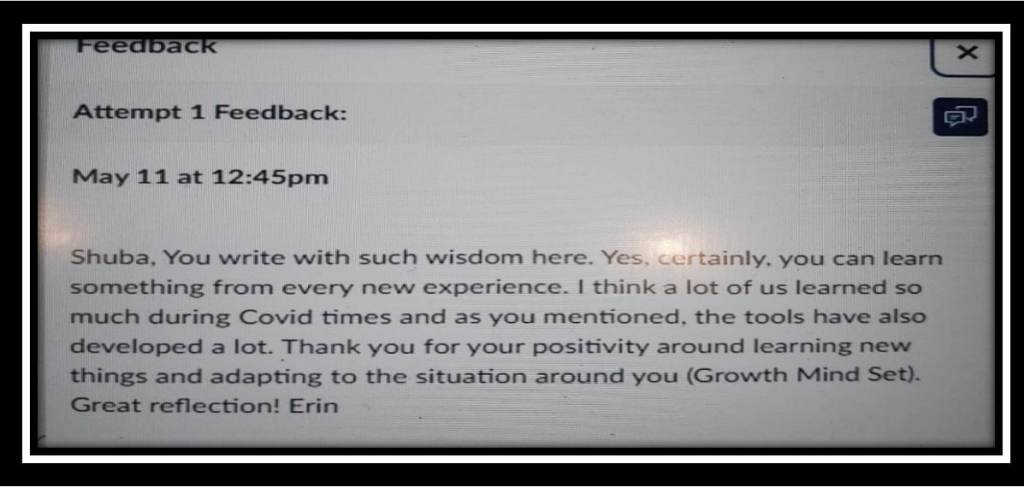
Peer Feedback on Online Discussion Forum
WRITTEN BY SHUBASHINI SUPPIAH

Shubashini Suppiah is a teacher educator at the Institute of Teacher Education Gaya Campus in Kota Kinabalu, Sabah Malaysia. Her areas of research interests are teacher education and teacher professional development, reflective practice approaches and digital literacy in the ESL classroom.

