
“Your bank detects fraud before you notice it. Netflix recommends your next favourite movie. Your online shopping app seems to know what you want before you do. Coincidence? Not quite. Welcome to the age of Artificial Intelligence.”
Artificial Intelligence (AI) has quietly become part of our everyday lives. We interact with AI when unlocking smartphones through facial recognition, using virtual assistants, receiving personalised advertisements, or making digital payments. What once belonged largely to science fiction is now reshaping how Malaysian businesses operate and compete. This transformation is occurring within a rapidly expanding digital economy. According to the Department of Statistics Malaysia (DOSM), information and communication technology (ICT) and e-commerce contributed 23.4% to Malaysia’s economy in 2024, equivalent to RM451.3 billion (DOSM, 2025a). At the business level, 97.2% of Malaysian establishments reported using computers in 2024, highlighting the increasingly digital environment in which AI adoption is taking place (DOSM, 2025b).
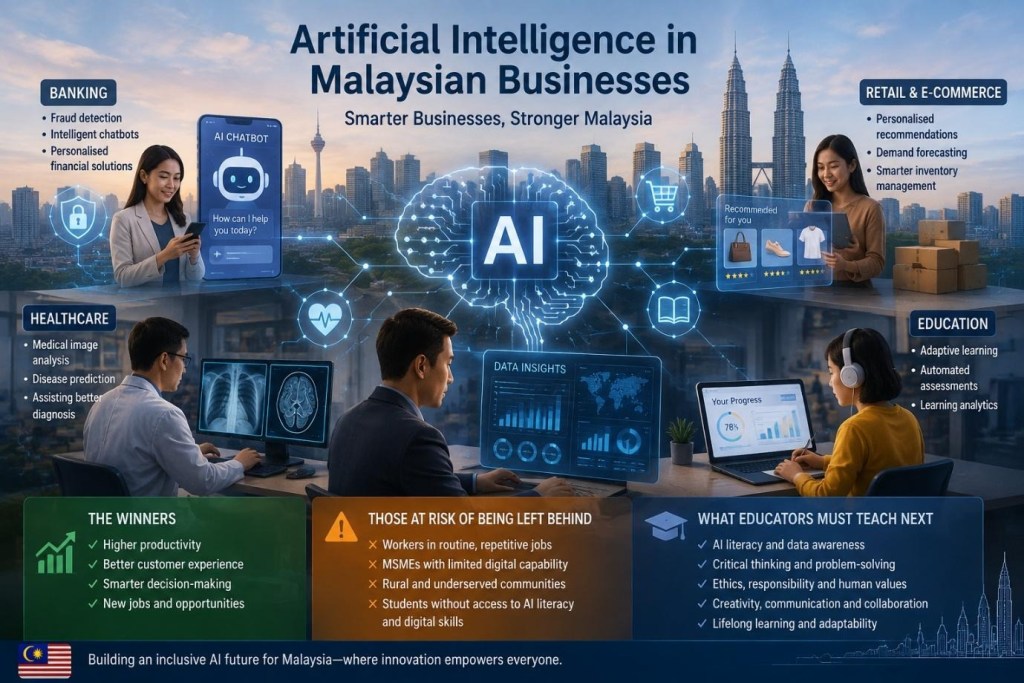
At the same time, some groups may be more exposed to the transition. Workers performing highly routine and repetitive administrative tasks may face greater pressure to reskill or redesign their roles. Small businesses with limited capital, weak data practices, or insufficient digital expertise may struggle to adopt AI effectively. Rural and less digitally connected communities may have fewer opportunities to access AI-enabled services and training. Students who graduate without AI literacy may also find it harder to compete in workplaces where AI-supported workflows are becoming normal. Recent Malaysian labour-market analysis similarly notes that AI may create high-skilled employment and productivity gains while affecting workers in semi-skilled and low-skilled roles, particularly where tasks are routine and repetitive (Department of Statistics Malaysia, 2026).
Yet AI is much more than a technological trend. It is transforming industries, redefining jobs, and changing the skills needed to succeed. As Malaysia accelerates its digital transformation agenda, one question deserves serious attention: Who truly benefits from AI, and who risks being left behind?
AI Is No Longer Just for Tech Giants
Many people still believe AI is only accessible to global technology companies with enormous budgets. That perception is changing as cloud computing, machine-learning platforms, and generative AI tools become more accessible. This matters particularly for Malaysia’s micro, small and medium enterprises (MSMEs), which numbered more than one million establishments in the 2022 reference year and accounted for a substantial share of the country’s business landscape (Department of Statistics Malaysia, 2024). However, accessibility does not mean equal readiness. Smaller firms may face constraints involving finance, skilled personnel, data quality, digital infrastructure, cybersecurity, and the ability to integrate AI into existing workflows.
Rather than replacing people, AI is increasingly becoming a powerful co-worker. It analyses massive volumes of data within seconds, identifies hidden patterns, predicts customer behaviour, and supports better business decisions. Human expertise, however, remains essential for creativity, ethical judgement, leadership, and strategic thinking.
Malaysian Businesses Are Already Embracing AI
AI is increasingly becoming relevant across Malaysian industries, although the depth of adoption differs between organisations and sectors. In banking, AI can support fraud detection, customer service, risk assessment, personalised recommendations, and other data-intensive activities. In retail and e-commerce, AI can support recommendation systems, demand forecasting, customer analytics, and inventory planning. In healthcare, AI can assist professionals by analysing information and supporting clinical decision-making. In education, AI-enabled tools can support personalised learning, assessment, content development, and learning analytics. These examples illustrate the breadth of AI’s potential, but they also highlight an important principle: AI adoption should augment human expertise rather than remove accountability from the people and organisations responsible for outcomes.
In banking, AI detects fraudulent transactions within seconds, evaluates credit risks, automates customer support through intelligent chatbots, and recommends personalised financial products. Customers enjoy faster services, while banks improve efficiency and security.
The retail and e-commerce sector has become equally intelligent. Every product recommendation on Shopee or Lazada, every personalised promotion, and every inventory forecast is increasingly powered by AI. Businesses better understand customer preferences while reducing operational waste.
In healthcare, AI assists doctors by analysing medical images, predicting disease risks, and supporting faster diagnoses. Importantly, AI does not replace healthcare professionals—it enhances their ability to make informed clinical decisions.
Meanwhile, education is entering its own AI revolution. Adaptive learning platforms personalise lessons according to each student’s progress, automated assessments reduce teachers’ administrative burden, and learning analytics help identify students who need additional support. Yet no algorithm can replace a teacher’s empathy, encouragement, or ability to inspire curiosity.
The Winners and Those at Risk
AI creates significant opportunities, but its benefits are unlikely to be distributed equally. Businesses with strong digital infrastructure, quality data, financial resources, and skilled employees may be better positioned to adopt AI and capture productivity gains. Employees whose roles involve analysis, problem-solving, customer engagement, digital tools, and decision support may also benefit when AI complements their work. Consumers can benefit from faster services, greater personalisation, improved fraud detection, and more responsive customer support.
However, AI is not without challenges. The first concern is data privacy. AI depends on large amounts of personal information, making responsible data governance more important than ever. The second challenge is algorithmic bias. AI systems learn from historical data, and if that data contains bias, the technology may unintentionally produce unfair or discriminatory decisions. Finally, there is growing concern about the future of work. While certain routine jobs may disappear, history shows that technological revolutions create entirely new careers. The real challenge is not whether AI will replace people it is whether people are prepared to work alongside AI.
The Skills That AI Cannot Replace
As AI systems become more capable, the value of human judgement and interpersonal capabilities becomes increasingly important. Employers need graduates who can think critically, solve complex problems, communicate effectively, collaborate across cultures, understand business contexts, and make responsible decisions. Creativity, empathy, adaptability, leadership, ethical reasoning, and domain expertise remain important human capabilities, while AI can support people in developing and applying these capabilities. The goal, therefore, should not be to claim that AI can never perform aspects of these activities, but to ensure that people remain capable of questioning, supervising, interpreting, and taking responsibility for AI-supported work.
This means universities and colleges must prepare students not simply to use AI, but to manage it responsibly and apply it strategically in business environments.
Bringing AI into the Business Classroom
Malaysia is also building an institutional framework around responsible AI adoption. The National AI Office (NAIO), launched in December 2024, was established to coordinate Malaysia’s AI agenda, accelerate adoption, develop talent, and support ethical and inclusive AI development. In September 2024, the Ministry of Science, Technology and Innovation also launched the National Guidelines on Artificial Intelligence Governance and Ethics (AIGE), which emphasise responsible AI development and use. These initiatives provide a useful Malaysian policy context for business educators because they show that AI competence must include not only technical capability but also governance, ethics, risk awareness, and inclusion (Ministry of Digital Malaysia, 2024; Ministry of Science, Technology and Innovation, 2024).
Business education must evolve as rapidly as technology itself. Students need more than basic exposure to AI tools; they need the ability to evaluate AI outputs, protect data, recognise bias, assess business value, understand governance requirements, and make decisions about when human judgement should take priority. This is particularly important in Malaysia, where national AI initiatives emphasise responsible, inclusive, and future-ready AI development.
Such activities encourage students to connect classroom theories with real-world business challenges while developing communication, analytical thinking, teamwork, and ethical decision-making skills.
To encourage deeper reflection, educators might ask:
- · Would you trust AI to support a bank-loan decision?
- · Should AI make or support hiring decisions?
- · How can Malaysian businesses remain globally competitive as AI adoption expands?
- · Which jobs are most likely to evolve rather than disappear?
There are rarely simple answers, but these are precisely the conversations tomorrow’s business leaders need to have.
Looking Ahead
Artificial Intelligence is no longer a distant possibility; it is becoming an important part of today’s business environment. Malaysian organisations that adopt AI responsibly may be better positioned to innovate, compete, and deliver value to customers, while organisations that delay digital transformation may face increasing competitive pressure. However, responsible adoption requires more than purchasing AI tools. It requires investment in people, data quality, cybersecurity, governance, digital infrastructure, and continuous learning.
For educators, the challenge extends beyond teaching students how to use technology. Our responsibility is to develop graduates who combine technological competence with ethical leadership, creativity, critical thinking, and lifelong learning.
After all, the future does not belong to humans or AI alone. It belongs to those who understand how both can work together to solve tomorrow’s business challenges.
References
Department of Statistics Malaysia. (2024). Economic Census 2023: Profile of micro, small and medium enterprises. https://www.dosm.gov.my/portal-main/release-content/economic-census-2023-profile-of-small-and-medium-enterprises
Department of Statistics Malaysia. (2025a). Malaysia digital economy, 2025. https://www.dosm.gov.my/portal-main/release-content/malaysia-digital-economy-2025
Department of Statistics Malaysia. (2025b). Usage of ICT and e-commerce by establishment 2025. https://www.dosm.gov.my/portal-main/release-content/usage-of-ict-and-e-commerce-by-establishment2025
Department of Statistics Malaysia. (2026). The adaptation of artificial intelligence (AI) in Malaysia’s labour market. https://www.dosm.gov.my/portal-main/release-document-log?release_document_id=17369
Malaysia National AI Office. (2024). National AI Office (NAIO). https://ai.gov.my/about-naio/
Ministry of Science, Technology and Innovation. (2024, September). Artificial intelligence governance and ethics guidelines (AIGE): The national guidelines on AI governance and ethics. https://mastic.mosti.gov.my/publication/the-national-guidelines-on-ai-governance-ethics/
Written by Mary Grace K. Orow

Mary Grace K. Orow is a Business Studies lecturer with over 13 years of industry experience across the banking, retail, and airline sectors. Throughout her career, she has been involved in customer relationship management, financial advisory, and digital banking operations, experiences that she now incorporates into her teaching to bridge academic concepts with real-world business practice.
Her teaching and research interests include digital transformation, financial literacy, entrepreneurship, and emerging business technologies. She is committed to equipping students with practical knowledge, critical thinking skills, and an ethical perspective to help them navigate the evolving demands of today’s business environment.
 HIVE Educators | Cultivating teacher-scholars