
When Capable Readers Sound Like Robots
Teaching Advanced Reading to university students has made me pay closer attention to what happens when silent reading becomes audible. Students can navigate challenging passages and discuss their ideas. Yet, when asked to read aloud, some sound flat and mechanical- almost robotic. Important words receive little emphasis, while pauses separate ideas that belong together.
I found myself wondering: how could I help students make their understanding heard? Asking them to “read with expression” offered little direction. They needed guidance to connect meaning on the page with the voice delivering it. This concern inspired my Vocal-Architectural Scaffold for Prosody model, or VASP.
The Missing Bridge Between Reading and Voice
University reading lessons understandably emphasise making inferences, evaluating arguments and interpreting complex texts. However, rhythm and expression can slip into the background. Prosody often receives explicit attention when younger learners are taught to read, yet takes a back seat in adult reading instruction- where fluent, expressive reading may be assumed rather than taught.
My classroom experience encouraged me to question that assumption. Prosody, which includes phrasing, stress, rhythm and intonation, deserves explicit attention even among capable readers. Students need to explore where pauses belong, how emphasis shapes interpretation, and what their delivery reveals about understanding. VASP makes this relationship between meaning and voice visible and teachable.
The Silent Ear: Hearing Meaning Within the Text
VASP follows five stages: Read, Understand, Visualise, Vocalise and Internalise. Students engage with a text, identify its central meaning, annotate expressive cues, read aloud purposefully, and practise towards independence.
The framework draws on Cognitive Load Theory and the Implicit Prosody Hypothesis. The former informs how I help students organise complex sentences into manageable parts. The latter proposes that silent readers generate an internal prosodic representation, an “inner voice” contributing to interpretation.
I think of this as the “silent ear”. VASP encourages students to notice this voice and consider how meaning should sound. My guiding principle is simple: understand the message before deciding how to deliver it.
Reading with Purpose, Speaking with Confidence
I developed VASP with three objectives: i) improving fluency through meaningful phrasing, pauses and emphasis; ii) deepening comprehension of sentence structure and key information; and iii) encouraging confidence, independence and reading enjoyment.
Expressive reading becomes an opportunity to examine understanding. Choosing which words to emphasise requires students to ask what matters. Deciding where to pause requires them to recognise how ideas belong together.
Twenty-Five Learners, One Shared Learning Hub
The initial implementation involved 25 CEFR B2–C1 undergraduates in an Effective Reading course at Universiti Sains Malaysia over three to four weeks.
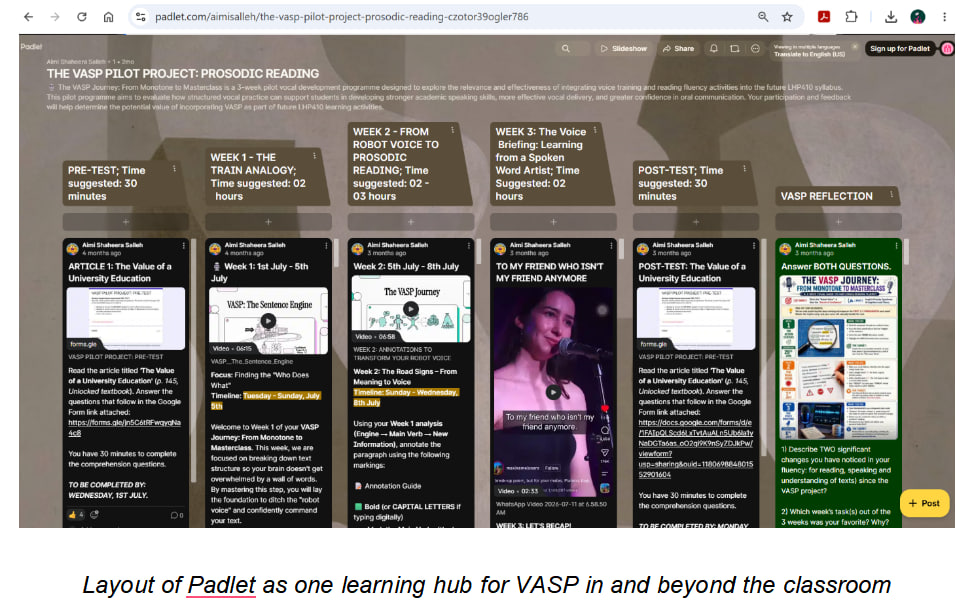
Padlet brought together weekly instructions, reading materials, multimedia resources and submissions. NotebookLM AI-generated video explainers allowed students to revisit explanations independently. Google Forms supported formative tasks and reflection, while annotated passages and audio or video recordings documented students’ application of VASP. These tools extended practice beyond classroom time. Pre- and post-tests were also administered to track changes in reading comprehension.
A Three-Week Journey: Engine, Road Signs and Voice
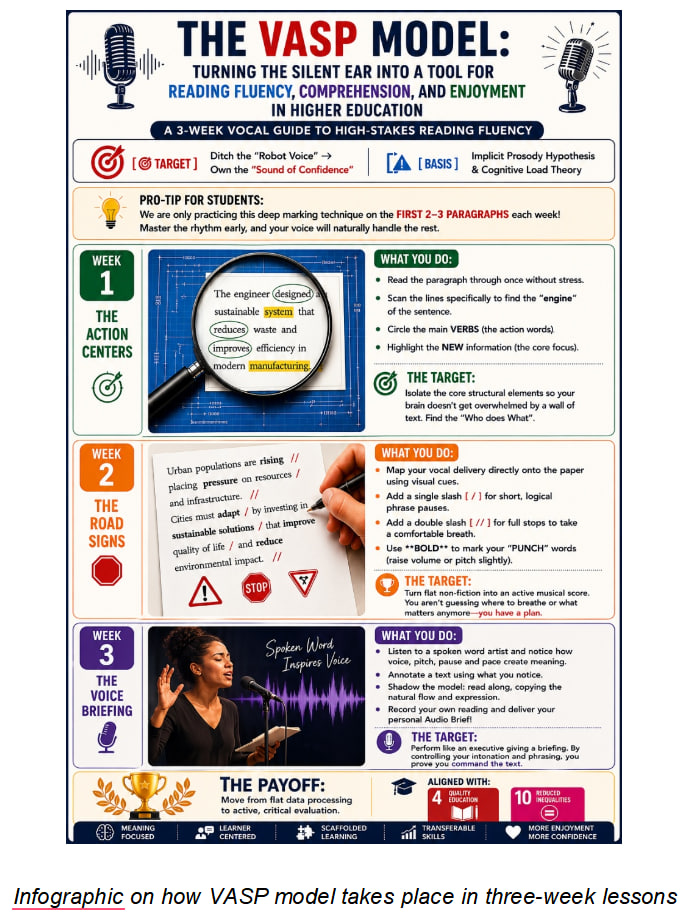
Week 1: Finding the Engine. Students identified the subject, main verb and key information. The “Engine” metaphor helped them locate a sentence’s central structure before considering additional details. An authentic article about Gen Z and dating provided practice in identifying who or what a sentence concerned, what happened, and which information advanced its meaning.
Week 2: Following the Road Signs. Students translated understanding into annotations for oral reading. A single slash (/) indicated a short pause, while a double slash (//) marked a longer one. Main verbs and new information received visual emphasis. An article about the abolition of Malaysia’s jury system helped students explore how these cues could guide listeners through the text.
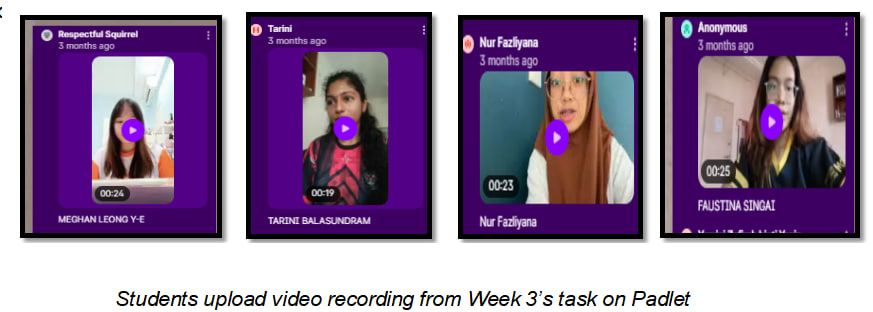
Week 3: Borrowing the Voice. A spoken-word poem about friendship introduced emotional expression. Students observed the performer’s pitch, pacing and cadence before producing their own recordings. The model demonstrated how voice communicates feeling and intention while leaving room for individual interpretation.
The sequence progressed from identifying meaning to planning expression and applying it through voice.
Small Changes, Encouraging Signals
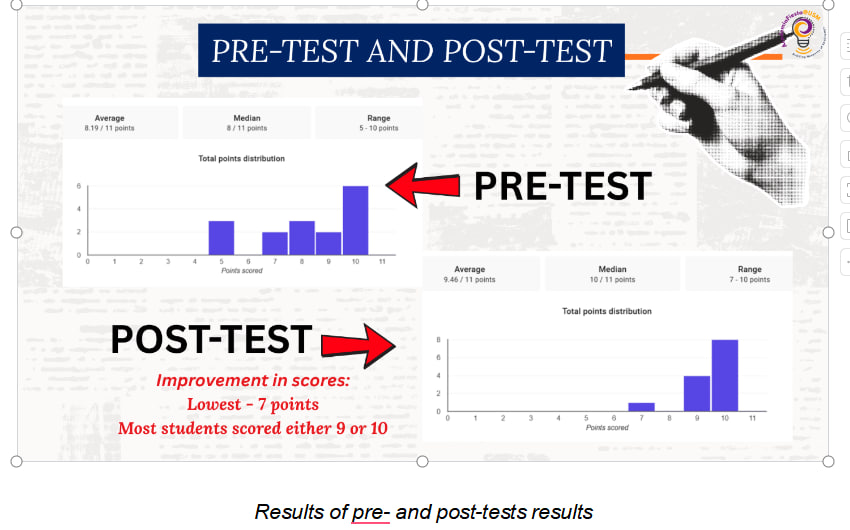
Reported test averages rose from 8.19 to 9.46 out of 11. The lowest recorded score increased from five to seven, with most post-test respondents scoring nine or ten. Different response totals mean these results remain preliminary descriptive evidence.
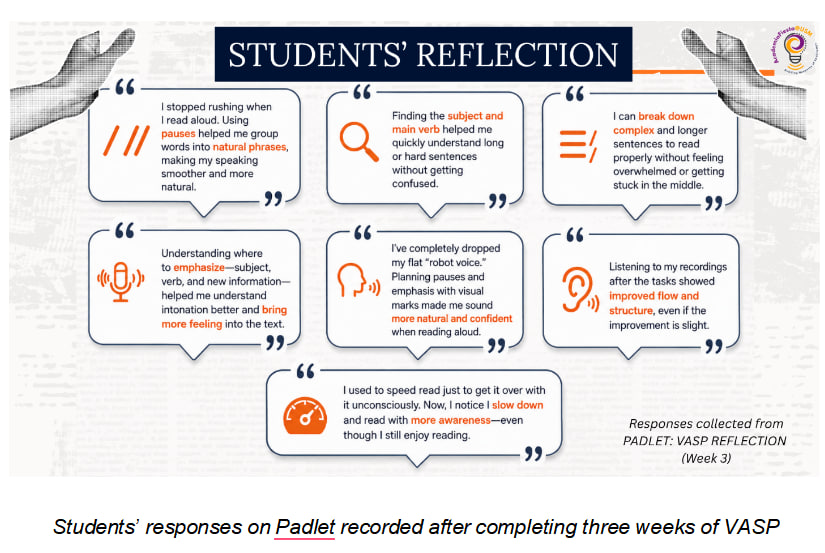
Student reflections offered further insights. Some reported greater ease in identifying sentence structure and key information. Others valued knowing where to pause and emphasize words so listeners could follow. The poetry task also prompted enjoyment and personal connection. These responses reminded me that “read with expression” becomes more useful when students have a tangible process to apply.
Beyond the Reading Classroom
Just as VASP elevates the reading experience in the classroom, it also supports independent and self-paced, AI-assisted learning beyond the classroom. Future development could include carefully designed prosody rubrics to evaluate progress using matched pre- and post-assessments.
VASP sparks a conversation about how expression deepens understanding. Students approach challenging texts with greater clarity as they hear meaning take shape in their own voices. For me, VASP has ultimately newed the pleasure of teaching reading as a meaningful act of communication.
REFERENCES
AskLegal.my. (n.d.). Malaysia abolished trial by jury in 1995. A bomoh’s murder trial is widely blamed for it. https://asklegal.my/p/what-is-the-jury-system-and-why-was-it-abolished-in-malaysia-mona-fandey
Fodor, J. D. (2002). Psycholinguistics cannot escape prosody. In Proceedings of Speech Prosody 2002. https://doi.org/10.21437/SpeechProsody.2002-12
Meixner, M. [@maxinemeixnerx]. (2026, July 6). A break-up poem, but for your mates. Platonic love is one of my favourite things [Video]. Instagram. https://www.instagram.com/reels/DadYcxUIPc9/
Sweller, J. (1988). Cognitive load during problem solving: Effects on learning. Cognitive Science, 12(2), 257–285. https://doi.org/10.1207/s15516709cog1202_4
Trivedi, A. (2026, June 13). Gen Zers are more risk-averse. Experts say it’s ruining their dating lives. CNN. https://edition.cnn.com/2026/06/13/health/gen-z-dating-risk-aversion-wellness
WRITTEN BY Ms. AIMI SHAHEERA SALLEH

Aimi Shaheera Salleh teaches English at the School of Languages, Literacies and Translation, Universiti Sains Malaysia, Penang. Her interests include innovative teaching, student-led learning and integrating technology to support learner autonomy. With a love of pop culture and the everyday stories of ordinary people, she brings authentic texts and real-world experiences into her classroom to bridge generational gaps and make language learning relevant, engaging and meaningful.

